
Why Therapeutically Simpler Products Are Strong Candidates for the FDA AI-Enabled Optimization of Early-Phase Clinical Trials Pilot Program

Executive Summary
The FDA’s AI-Enabled Optimization of Early-Phase Clinical Trials Pilot Program offers a valuable opportunity to test how artificial intelligence can accelerate pharmaceutical development while preserving rigorous scientific and regulatory standards.
This Technical Note proposes that early pilot programs may achieve the greatest long-term impact by initially focusing on therapeutically simpler but broadly representative platforms, such as topical products and intranasal therapies, before progressing to more complex modalities (e.g., cell and gene therapies). These platforms share the large majority of the core pharmaceutical development framework, including Chemistry, Manufacturing, and Controls (CMC), regulatory strategy, nonclinical development, clinical protocol design, safety monitoring, and quality systems. Validating AI tools in these settings generates broadly transferable methodologies that can later be efficiently adapted to more specialized components. This progressive approach maximizes learning, improves transferability, reduces early risk, and accelerates overall AI adoption across the pharmaceutical ecosystem.
This paper is also available at:
https://doi.org/10.5281/zenodo.20943117

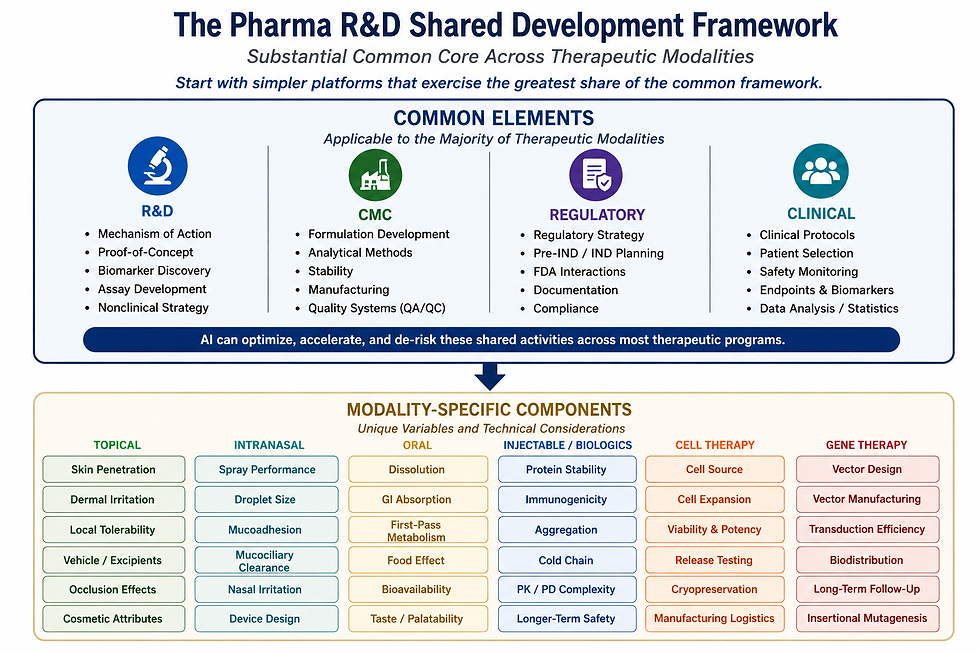
Figure 1. The Pharma R&D Shared Development Framework: Common Core vs. Modality-Specific Components. Most pharmaceutical development activities (CMC, regulatory strategy, nonclinical testing, clinical design, safety monitoring, and quality systems) are common across therapeutic modalities and represent the largest opportunity for transferable AI optimization.
IntroductionArtificial intelligence has the potential to transform nearly every stage of pharmaceutical development, including regulatory document preparation, Chemistry, Manufacturing and Controls (CMC), formulation optimization, biomarker discovery, clinical trial design, patient selection, safety monitoring, adaptive dose optimization, manufacturing optimization, and regulatory submissions. The FDA pilot program appropriately recognizes these opportunities. However, an important strategic question remains: Which therapeutic platforms should serve as the initial test cases?
This paper proposes that pilot programs should begin with products that exercise the greatest proportion of the shared pharmaceutical development framework before progressing to increasingly specialized therapeutic modalities.
The Shared Pharmaceutical Development Framework
Although therapeutic products differ in formulation, manufacturing, and mechanisms of action, much of the pharmaceutical development process remains consistent across modalities. Shared activities include:
Discovery and translational research
CMC development and analytical method development
Manufacturing quality systems
Regulatory strategy and IND preparation
Nonclinical testing
Clinical trial design and biomarker development
Statistical analysis and safety monitoring
Regulatory documentation
AI systems developed for these foundational activities have the potential to benefit a broad range of future investigational products. Figure 2. Illustration of the Core Pharmaceutical Development Framework. Foundational activities such as regulatory preparation, CMC, nonclinical development, clinical protocol design, and safety monitoring are shared across the majority of investigational products, enabling AI tools developed in these areas to benefit a broad range of future programs.

Modality-Specific Complexity
Every therapeutic platform also introduces unique technical considerations. Examples include:
Topical Products: Skin penetration, dermal tolerability, local residence time
Intranasal Products: Spray performance, mucoadhesion, mucociliary clearance, device optimization
Oral Products: Dissolution, gastrointestinal absorption, first-pass metabolism
Injectable Biologics: Protein stability, immunogenicity, cold-chain management
Cell Therapies: Cell sourcing, cell expansion, release testing, chain of identity
Gene Therapies: Viral vector development, biodistribution, long-term follow-up
These activities are essential for their respective modalities but are substantially less transferable across the broader pharmaceutical ecosystem than the common development framework.
Why Therapeutically Simpler Platforms May Be Ideal Pilot Programs
Pilot programs should maximize learning that can subsequently be transferred to future investigational products. Products such as topical therapies and intranasal formulations provide several advantages:
Relatively straightforward CMC programs
Lower manufacturing complexity
Local biological endpoints
Rapid formulation iteration
Well-established regulatory pathways
Faster proof-of-concept studies
Importantly, these products still exercise many of the same regulatory, CMC, clinical, and quality-system processes required for more complex products. Accordingly, AI methodologies validated in these settings may have broad applicability to future development programs.
A Progressive Strategy for AI Adoption
Rather than beginning with the most technically complex therapeutic platforms, an incremental strategy may maximize both regulatory confidence and scientific learning.
A progressive implementation strategy could include:
Stage 1: Topical products, Intranasal products
Stage 2: Oral products, Injectable biologics
Stage 3: Combination products, Cell therapies, Gene therapies
Lessons learned from earlier stages can inform AI implementation in increasingly specialized therapeutic areas while reducing development risk and improving regulatory confidence.

Figure 3. A Progressive Strategy for AI Adoption in Pharmaceutical Development. An incremental approach that begins with therapeutically simpler platforms (topical and intranasal products) before advancing to more complex modalities (cell and gene therapies) may maximize learning, improve transferability of AI methodologies, and accelerate broader adoption while reducing early regulatory and technical risk.
Broader Implications
Artificial intelligence developed for regulatory writing, CMC optimization, clinical protocol development, biomarker identification, safety monitoring, data integration, and adaptive trial design may ultimately benefit a substantial proportion of future pharmaceutical development programs regardless of therapeutic modality.
Beginning with broadly representative products may therefore maximize the return on investment from the FDA pilot while establishing validated methodologies that can subsequently be adapted to increasingly specialized products.
Conclusion
The FDA AI-Enabled Optimization of Early-Phase Clinical Trials Pilot Program represents an important opportunity to modernize pharmaceutical development.
A progressive implementation strategy that begins with therapeutically simpler but broadly representative products may maximize learning, improve transferability of AI methodologies, strengthen regulatory confidence, and ultimately accelerate adoption across the pharmaceutical ecosystem.
References
FDA-2026-N-4390 and selected references on AI in pharmaceutical development, CMC, adaptive clinical trials, regulatory science, and therapeutic modality development.
You can submit your own response at:
Appendix:
Figure 4. Shared vs. Modality-Specific Development Activities Across Therapeutic Platforms. While all products require core pharmaceutical development processes, each modality introduces specialized considerations (e.g., spray performance and mucoadhesion for intranasal products, viral vector development for gene therapies). AI validated on shared activities has higher transferability across the ecosystem.


Comments